Historical Narratives |
MACRIS Listings for Winthrop, Mass.
|
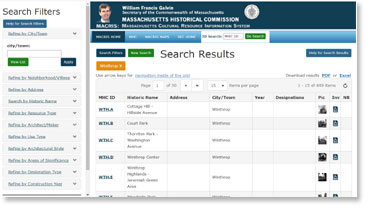
The Massachusetts Cultural Resource Information System (MACRIS) is an online resource for searching the Massachusetts Historical Commission database of historic properties and areas in the Commonwealth. Remarkably, there are over 400 records for Winthrop. |
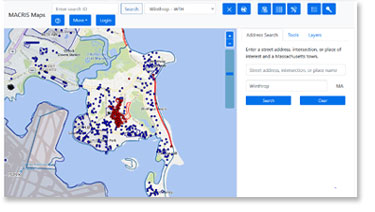
Click here to search the database on the MACRIS website. Click the map below to view the new MACRIS Maps website. |
|
| Property Name |
Category |
Address |
Year |
Detail
Page |
National
Register |
| Cottage Hill - Hillside Avenue |
Area |
|
|
WTH.A |
|
| Historial Narrative excerpt: "Probably the greatest feature of the Eighties in Winthrop was the beginning of a comparatively huge real estate development. In 1882 Great Head, or Cottage Hill as it was soon named, was surveyed for house lots and the owners, Gerry Tewksbury, J.W. Tewksbury and the Wyman Brothers offered their respective properties for sale." In the Spring of 1883, wealthy Boston leather merchant William B. Rice purchased Cottage Hill from its aforementioned owners.Rice was simultaneously developing his lands at Winthrop Highlands. It is interesting to compare the relatively modest, wood vernacular houses of Cottage Hill with the more self consciously stylish and substantial houses of the Highlands. At any rate Whitman and Breck were hired to set out the streets over Cottage Hill's rugged terrain that local skeptics judged impossible to tame. Rice planted 150 trees on the hill and began building a pier 250 feet long into the ocean. The organization of the Winthrop Yacht Club in 1884 undoubtedly served as an attraction for persons considering this area as a summer retreat. By 1886 there were two dozen or so summer residences extant on Cottage Hill, including 67 Cottage Avenue ( MHC#3^)in the proposed Cottage Hill/Hillside Avenue historic district.Overtime, Cottage Hill attracted a solid, middle class I summer clientel to its wind swept, sun washed slopes including Albert P. Crossman, salesman (5 Hillside Avenue, early 1900's), Hollis B.'Scates, buyer (67 Cottage Avenue, 1910's), Daley J. Gaudet , carpenter (20 Prospect Avenue, 1920's, MHC#i^t> )etc. As this great eminence became more and more built up , Cottage Hill superseded Great Head as the name of this drumlin, although many locals persist in calling it Great Head. William H. Clark notes that Winthrop became almost exclucively a year round community by the end of World War II. By that time, most of Cottage Hill's housing had been winterized. Although much has been written about Nahant, Newport R.I. and Bar Harbor as summer playgrounds of the rich, little press has been given to working class and middle class summer resorts of the Victorian and Edwardian Eras in New England. The architectural and historical significance of the proposed Cottage Hill/Hillside Avenue Historic District lies in its largely unspoiled physical evidence of life in a late Victorian Era summer colony of "ordinary " vacationers of relatively modest means. It also indirectly speaks to the profound changes that resulted from the introduction of steam railroads to Winthrop during the last quarter of the 19th century. Winthrop, long the near private preserve of a handful of families, was hence forth opened up to seasonal and permanent commuters .beginning in 1883 on steep, hilly upland that had been part of the John S. Tewksbury family's extensive land holdings. This eminence is bordered by the Atlantic Ocean on the East, Short Beach on the South, Boston Harbor on the West and Winthrop Beach on the North. Developed by Boston leather merchant and real estate speculator William B. Rice and set out by Whitman and Breck engineers. This district is small and linear taking in both sides of Hillside Avenue between Crystal Cove Avenue and Prospect Ave, but within its borders are several very well preserved and unusual Shingle Style and Queen Ann residences. This area appears to satisfy criteria A and C of the National Register of Historic Places on a local level..." |
| Court Park |
Area |
|
|
WTH.B |
|
| Historial Narrative excerpt: "Court Park was the last large area to be developed for residential purposes in Winthrop.House construction began c. mid 1890's, intensified during the early 1900's and continued until the mid 1920's. Beginning in late 1630's, Court Park's land was included in the "Great Allotments" of Elias Maverick and Valentine Hill.By the mid 17th century,this area was part of James Bill Sr. 's extensive landholdings. The purchase of Court Park in 1847 by Edward G. Loring and George B. Emerson, represents a water shed in Winthrop's History. For the first time an extensive tract was purchased for the purpose's of a gentleman's estate rather than for strictly agricultural purposes. Loring became familiar with this area as a young man from bird hunting expeditions "along the wild Winthrop shore" and steam ferry trips between Boston and Nahant .Edward G. Loring was a Harvard lecturer jawyer, and justice of the U.S. Court of Claims in Washington D.C.George B. Emerson was a nationally recognized educator,teacher.naturalist, and botanist. Emerson may be credited with shaping Court Park's leafy look, planting over 1500 native and European trees. Emerson's house was located near the present 31 Emerson Road. This house was close to the harbor near Court Road and Sargent Street. The Emerson House was demolished during the 1890's while the Loring House lingered into the early 1900's as the club house for a short lived golf course. John Lowell was a later owner of the Emerson House.Both Court Park's estate and residential subdivision phases are well documented in two plans. Landscape gardener Joseph H. Curtis's sketch map of 1887 shows the locations of the Loring and Emerson/Lowell houses as well as driveways, stables and willow trees. A. c.1891 plan shows a meandering system of roads which more or less echos the present street pattern.Deed restrictions for Court Park's lots stipulated that houses had to built at above minimum cost, insuring the construction of substantial residences that would carry on an estate- like appearance within this area .By the early 1920's Court Park had become an affluent suburban enclave of lawyers, contactors, doctors and engineers..." |
| Thornton Park - Washington Avenue |
Area |
|
|
WTH.C |
|
| Historial Narrative excerpt: "During the 17th century the Thornton Park/Washington Avenue area was owned by Major Edward Gibbons who was a friend of Governor Winthrop's and was one of Boston's most prominent merchants, ship-owners and soldiers.The Gibbons house was located near the intersection of Winthrop/Pleasant/Washington. As late as 1912, the Gibbons Elm, an ancient tree planted in Gibbons time, stood near the south side of this intersection. During the | 18th century, this area was part of James Bill's extensive land holdings. During the first half of the 19th century, this area seems to have been essentially the private preserve of George Washington Tewksbury, one of the first | highway surveyors in Winthrop. He was one of 49 signers of Winthrop's declaration of independence from North Chelsea (Revere) in 1852. During the last quarter of the 19th century, Tewksbury was joined by Belchers, Floyds, Paines and Thorntons as land owners at what was sometimes called Pleasant Point, an area bounded by Boston Harbor on the south and on the north by Crystal Cove and associated creeks, now Lewis Lake ParkJohn Wingate Thornton, founder of the New Historic Genealogical Society in Boston owned the Thornton Park area .He lived near the Belle Isle Inlet Bridge at the corner of Main and Pleasant Streets.Thornton was numbered among the developers who took advantage of the opening of a bridge across Crystal Cove from Washington Avenue to Shirley Street at Winthrop Beach. This bridge ended this area's days of bucolic isolation, ushering in a building boom that lasted into the second decade of the 20th century.The introduction of the Narrow Gauge Railroad to the town in 1888 made living in this area more conveinent than ever before with the Thornton Station located near the intersection of Pleasant/Winthrop and Washington.From c. 1880 until World War I, a summer colony of the newly well-to do sprang up along Washington Avenue.Men like William Mc Kie, shipbuilder (35 Washington Avenue) all succumbed to this area's salty, picturesque harborside charms during the late 19th and early 20th centuries. In addition to the well to do commuters from this area to Boston, Chelsea and East Boston there was also a representation of local people with businesses at the town center. Wilbert W. Freeman of 15 Washington Avenue (MHC# I^-Q) was the proprietor of the Centre Hardware and Variety Store.George F. Sweeney of Sweeney and Rich Grocery Store at Winthrop Center built #25 Washington Avenue c.1902 (MHC# zzj).Elmer E. Dawson of 28 Washington Avenue was described in William H. Clark's History of Winthrop as "one of the most valuable public servants the Town has been fortunate enough to have".Dawson , a flour broker in Boston, was active on committees to raise money to build the Winthrop Library and Winthrop Hospital. Similarly, Thornton Park had its share of prominent citizens at the turn of the century. Although New England Historic Genealogical Society founder John Wingate Thornton, never lived here, he probably deserves credit for choosing the ornamental oval park plan for this area. Thornton Park eventually attracted a solid, stable middle to upper middle class. #15 Thornton Park (MHC#-?*? )was the retirement home of Winthrop developer extraordinaire Hermon D. Tewksbury. He was responsible for setting out streets in the northern section of Winthrop Center during the early 1870's. Daniel H. Howes, owner of a steam ship and rail road supplies company on Atlantic Avenue in Boston had #40 Thornton Park (MHC# £il )built c.1896. Charles E. Spofford "purveyors of Teas and Coffees" on Broad Street in Boston moved into #52 Thornton Park (MHC# ) in 1903. In addition liquor dealers, stenographers. Salesman, machinists.accountants and printers called Thornton Park home during the early 20th century. The Thornton Park/Washington Avenue area is perhaps the most significant area within Winthrop from the point of view of planning and residential architecture. Its oval park plan almost certainly was inspired by the oval parks of Boston neighborhoods. This area's lots and houses continue to be well maintained and still is one of the most desirable places to live in the town.
..." |
| Winthrop Center |
Area |
|
|
WTH.D |
|
| Historial Narrative excerpt: "The first English settlement in Winthrop dates to the 1630's . Originally, Winthrop or Pullin Poynte as it was ' called, was an area of scattered farm houses .As early as the 1750's Point Shirley was the first area of relatively ( , ' ( dense settlement in Winthrop. Winthrop Center evolved as the focus of the town's municipal, religious, commercial and residential life over a period of about 150 years. This development was characterized by slow growth between the late 18th century and Winthrop's incorporation as an independent town in 1852. Winthrop Street was the first thoroughfare in this area, set out as a cross-town road as early as 1699. The establishment of a school house in 1805 on the site of the present police station at Pauline and Hermon Streets, Metcalf Square suggests that a sufficient number of families lived in this area to identify it as a rural village. (this school house is said to have been recycled as the second floor of #278 Winthrop Street (c. 1856, MHC#2Sif). At least one late 18th c. house and possibly more (interior inspection required to ascertain construction dates) survive in and around Metcalf Square. The nucleus of the old Samuel Belcher House at 257 Winthrop Street (MHC#£5$ exhibits timber markings and foundation treatments that suggest a c. 1780's or 90's construction date. Another late 18th c, dwelling known as the Burrill House once stood on the site of the Wadsworth Block.(MHC#Zf^) The William Belcher House at 131 Winthrop Street (MHGi&^which appears to be a c. 1840's Late Federal/Greek Revival residence, may have been constructed decades earlier. In any event, this house provides a glimpse of Winthrop Center when it was home to farmers and fishermen.By the time of the town's incorporation as a town independent of North Chelsea (Revere), Winthrop Center could easily have been called Belcher Village with yet another mid 19th century Belcher- owned farm house at 75 Hermon Street (MHC#r*#. During the early 1830's, a religious revival swept Winthrop resulting in the construction of a Methodist Church at Madison Avenue and Winthrop Street in 1834. This was the first church established in Winthrop, prior to the 1830's, Winthrops' families worshipped in Revere or, in the case of the Bill family during the 18thc. rowed across Boston Harbor to Old North Church in Boston's North End. The third First Methodist Church was built in 1930 at Metcalf Square (MHC#zso).The old portion of Winthrop Cemetary seems to have been established c.1830's-possibly at the same time as the organization of the Methodist Church on land formerly owned by Bills and Belchers. By 1856, Winthrop began to assume an architectural identity recognizable as a town center with the construction of a Greek Revival/Italianate Town Hall (demolished in 1929 )by Vermont -born carpenter George S. Shaw. He was a major land owner in this area and evidently built a number of mid 19th c. Winthrop Center dwellings including 57 Buchanan Street (MHC #26 ) and 35 Fremont Street (c.1860, MHC#^o ).Overtime, transportation developments triggered residential development at the town center. While there is little evidence that the first bridge links with East Boston's Orient Heights in 1834 triggered house construction at the Town Center, it is more likely that the coming of the first stage coach line between Winthrop and Maverick Square in East Boston in 1848 did have an impact on house construction activity at Winthrop Center. Example of possible transportation improvements- related mid 19th century development at Winthrop Center are George S. Shaw's residential development bordering the segment of Buchanan Street west of Winthrop Street (including Fremont Street) of the mid-late 1850's and Hermon S. Tewksbury's development that included Hermon, Cora, Lincoln, Centre and Atlantic Streets as well as parts of Winthrop and Main Streets of the early 1870's. The Charles H. Day House at 350 Winthrop Street (c.1885 ,MHC#Z4a), for example was built on land purchased from Hermon Tewksbury c.1885 . Tewksbury's residential development existed on paper by 1872 and may have been initiated by the introduction of the town's first horse railroad in 1871 (ceased operations in 1877). Hermon Tewksbury was a major shareholder in this railroad. It was the coming of the Boston, Winthrop and Point Shirley Railroad or "peanut" train in 1877 really marks the beginning of widespread house construction activities at Winthrop Center and elsewhere in the town. The completion of the Narrow Gauge Railroad's loop around the town in 1888 resulted in a stable, mostly dependaple mode of public transportation for the next 52 years. #355 Winthrop Street's (c.1885, MHC#Z67) represents a residence that may have been built in response to transportation improvements. Its lot was carved from the extensive real estate holdings of Boston leather merchant William Rice who is perhaps more often associated with residential development in Winthrop Highlands and Cottage Hill. During the last three decades of the 19th century, Winthrop Center's role as a focus for the spiritual life of the town was augmented by the construction of Bapist, Episcopal and Catholic church's. In 1867,a group of parishoners from the First Methodist Church withdrew to form a Baptist Society. By 1871, construction was underway on the First Baptist Church which is still extant at 60 Hermon Street, although adapted for reuse as a community theatre, (see MHC # £^). During the mid 1880's , James Nelson , Annie Wentworth and others initiated the first Episcopal church services in Winthrop. The present St. John's Episcopal Church was completed in 1887 at Bowdoin and Buchanan Streets (MHC#/g). The growth of the Iate19th/early 20th century Roman Catholic community is symbolized by St. John the Evangelist Church at Lincoln and Winthrop Streets (MHC#£$. Catholic workers associated with the Revere Copper Company worshipped at Point Shirley between 1853 and 1866 . Between 1866 and 1887, the few Catholics who lived in Winthrop had to commute to East Boston to worship. As early as 1881, the present church's lot was purchased with the intention of erecting a Catholic Church. Construction of St. John the Evangelist Church began in 1911 but was not completed until as late as 1923. The Christian Scientists began conducting services at Winthrop Center in January 1916 in the Wadsworth Building's Wadsworth Hall. (MHC#z<#). The Christian Science Church building at 165 Winthrop Street (MHC #z*4$) was a decade in the making, with its lot purchased in 1920 and dedication ceremonied conducted on November 30,1930. During the 1890's, Winthrop Center became the Town's medical center. Historically, Winthrop Center was evidently the home of most of the local doctors. Beginning c.1884, Dr. Horatio S. Soule lived and practiced at 270 Winthrop Street (MHC#2.£j). In 1897, Dr. Benjamin Hicks Metcalf began his quarter century of service to the medical needs of the town. The twin Colonial Revival buildings at 170 and 174 Winthrop Street served as his residence and hospital, resectively (MHC #2#,). Tragically his son and heir to his medical practice was killed in France during World War I and the doctor, himself, sustained serious injuries from war-related gas inhalation which forced him to leave Winthrop in 1921. The historic Hermon/Winthrop/Pauline Streets crossroads long known as Columbia Square was renamed Metcalf Square in honor of the doctor's son Richard F. Metcalf c.1920.(?). Between the 1880's and early 1930's, Winthrop Center gradually acquired a more architecturally sophisticated appearance as the rural village of farmers , fisherman, lobstermen and sail makers became the more urbane town center of tradesman, artisans and white collar professionals commuting to Boston, East Boston, Lynn , Chelsea and Revere. Early evidence of this concern for more urbane appearances may be found in Marcena Belcher's gift of a drinking fountain in the form of a bronze female figure with a drinking cup and pitcher. This fountain was placed on or near the grassy triangle at Metcalf Square containing the present Spanish American War Memorial. Unfortunately, the fountain, which gave an "artiste appearance" to the town center, dissapeared c. 1920's and at the present time efforts are underway to determine if this fountain was buried in Metcalf Square. Still extant to attest to the Town Center's increasing late 19th/early 20th century architectural sophistication are public buildings Unfortunately, Belcher's fountain dissapeared c.1920's and at the present time efforts are underway to determine if this fountain was buried in Metcalf Square. Still extant to attest to the Town Center's increasing late 19th/early 20th century architectural sophistication are public buildings such as the Itlalian Rennaissance Revival Frost Public Library of 1898, possibly the master work of local architect Willard M. Bacon's career.(MHC#yz); the Winthrop Center Fire Station, at 40 Pauline Street (MHC#iw.
..." |
| Winthrop Highlands - Jeremiah Green Area |
Area |
|
|
WTH.E |
|
| Historial Narrative excerpt: "The proposed Winthrop Highlands/Jeremiah Green Historic District represents a section of the greater Highlands neighborhood that retains a high degree of architectural integrity. This area still conveys the appearance of an upscale, turn of the century residential quarter, home to summer visitors, commuter heads of household, local businessmen etc.The Highlands encompass four hills. Like all the hills in Winthrop, these hills are drumlins composed of sand, pebbles,clay, small boulders etc.During the 1630's when the English first settled at Pullen Poynte (Winthrop), the town's hills are said to have had more tree cover than the barren hill tops that appear in late 19th century photographs taken just before extensive house construction. The early land owners in the Highlands included William Pierce, William Aspinwall.Thomas Butalph and Thomas Fayerweather. By 1690, Governor John Winthrop's son Deane Winthrop owned much of the Highlands.For much of the 19th century, the Highlands were a little frequented back water that was purchased by the City of Boston in 1868. The City's initial plan was to establish a "lunatic asylum" situated within a campus setting in the Highlands.Known as 'The City Farm",tnis scheme never materialized, resulting in the sale of this land in 1883. Wealthy Boston leather merchant William B. Rice purchased The City Farm only weeks after he had purchased Cottage Hill in Winthrop. The purchase of these two late Victorian era developments made Rice the largest property owner in the town. Just as at Cottage Hill, Rice hired the engineering firm of Whitman and Breck to lay out the streets and survey the house lots. It is instructive to compare these two residential developments of the 1880's.The Highlands' terrain, although hilly, did not possess the kinds of street and house construction problems inherent in the much more steep and ledgy upland of Cottage Hill. Cottage Hill's lots were smaller than those of the Highlands. The Highlands housing stock is more stylish and substantial than the , vernacular dwellings of Cottage hill. Many of the Highlands early houses seem to have been built as permanent residences while Cottage Hill was a summer colony from the start and remained a seasonal resort for decades. Factors in the development of the Highlands included the establishment of rail roads through the town during the 1870's and 80's while further study is needed to determine the impact of the construction of Forts Banks and Heath in the Highlands during the 1890's. During the early 1890's there was talk of the Highlands seceding from Winthrop because of a lack of effective sewerage facilities but the town soon rectified this problem . The ineffectual sewerage facilities may well have held more intensive development at bay until the mid 1890's. Indeed, a viewing of the 1886 Floyd Map of Winthrop reveals that the Highlands had only a half dozen homes in this area three years after Rice purchased this land from the City of Boston. Grovers Avenue, judging by the number of different early 20th century post card views of this thoroughfare, was the premiere street in the neighborhood with its ocean views, proximity to Winthrop Beach and the large, towered forms of its houses. By the early 1900's, house construction in the Highlands was underway in earnest. Further research is needed to identify Boston architects who almost certainly designed some of these houses. By 1920, the devastation of the old Highlands (grammar) School on Almont Street by fire necessitated the construction of the present Dalrymple school. The proposed Winthrop Highlands/Jeremiah Green historic district's late turn of the century inhabitants.was home to self made men who made comfortable livings as builders,bankers, provisions dealers, and saloon keepers. Jeremiah Green, a Boston saloon keeper was among the early residents of the Highlands. His Queen Anne house at 90 Highland Avenue and the adjacent brick stable (now a private home ,78 Highland Avenue) survive to document this area in the early years of its development. Green was also a contractor and may well have been responsible for the construction of his own house and others in the Highlands.Green was active on the local school board and is said to have made generous gifts to local charities. He lived at #90 until his death c.1920. His family lived here until well into the 1940's. Green also owned the well designed Colonial Revival house at 54 Highland Avenue (c.1900) and 64 Cliff avenue (1890-95). Another intersesting early resident of the proposed district was Pietro Terrille who evidently proffitted, judging by the size and style of his house at 44 Quincy Avenue (MHC#i-j3), from a Boston grocery store and as an importer of "Lucca Olive Oil." Further to the north east, 70 Cliff Avenue (MHC#55) was built c.1898 for Edward W. Hudson, officer of the Municipal Court of Boston. Henry A. Root, mason,moved into 110 Grovers Avenue (MHC# )with his family c.1900. This area was also host to several seasonal hotels including the Leighton House which stood on the site of the present Dalrymple School. The much altered Winthrop Arms, successor hostelry to the Argyle House Hotel (shown on the 1886 Map), is still in operation as a residential and hotel and restaurant and is encompassed within the proposed district. The proposed Winthrop Highlands/ Jeremiah Green Historic District is architecturally significant as an enclave of essentially intact Queen Anne, Shingle Style, Colonial Revival, Tudor and Craftsman Style houses (and combinations of these styles) which speak to the design skills .craftsmanship of the architects and builders who developed this area around the turn of the century. Its historical significants lies in its status as an early William B. Rice-developed residential section and as the home of self made men from Irish and Italian as well as Yankee backgrounds whose Highlands houses testified to their business success in the Boston metropolitan area...." |
| Woodside Park |
Area |
|
|
WTH.F |
|
| Historial Narrative excerpt: "Woodside Park was part of Edward Gibbons ' Winthrop lands during the mid 17th century.During the 18th century it was part of James Bill's extensive landholdings. Around 1850, Winthrop's harborside began to be carved up into the estates of Boston gentlemen.Further to the west of Woodside Park, Charles Bartlett, Judge Loring.George Emerson and later Dr. Samuel Ingalls all developed private estates characterized by tree lined drives,gently rolling hills and houses designed in the popular romantic styles of the day with views of crystal clear sheets of water. William Wood was numbered among these well-to-do "new-commers" to Winthrop.Further research is needed on Wood's background.lt is known that he was interested in public transportation improvements and was evidently among those who were instrumental in introducing the railroad to Winthrop in the 1870's. The Wood residence was located at the north west corner of Pleasant and Woodside Avenue. It was either taken down or moved c. 1950's to accomadate a nursing home. The Wood house lot had a system of meandering driveways which lead to the main house, a large stable and two small out buildings. William Wood died c.early 1880's.His son George Wood inherited a tract of land stretching from Pleasant Street to the harbor . A Suffolk County deed plan (Book 2306,End Page) dated September, 1886 shows this tract carved up into 36 houselots and Woodside Avenue, part of Plummer Street and an unnamed way that later became Dix Street.Six houses are shown on this plan as already extant.AH of these buildings are still extant and numbered ^ 4,10,16,20,26,32 Woodside Park and 9 Woodside Avenue.One wonders which eliptical park was concaved first? Woodside or Thornton? Both existed on papenat^ajbout tb^ same time with Woodeside Park's houses built first and apparrently at the same time, c. 1885- 1886.Besi©« park's speak to the tradition of oval park's introduced in Boston by Charles Bulfinch in 1793.This was a highly sophisticated urban planning concept introduced to a still rural/agricultural town. Towards the end of 1884, the area soon to become Woodside Park gained notoriety beyond Winthrop's shores when a human skeleton garbed in the clothing of a British marine was discovered at the foot of Woodside Avenue,near #9 . The body was identified as that of Thomas Dwife, a British marine killed during the Battle of Shirley Gut, May 19,1776. The American captain Mugford successfuly repelled British attempts to capture his stranded schooner Franklin, but died in the course of the battle. A bronze badge bearing the British coat of arms was found on the body, serving as a means of identification which had been hastily buried near Woodside Park's Beach. In 1885, Thomas Alva Edison,inventor of electric lights and the phonograph, wasa summer visitor to Woodside Park, staying with a Mr.and Mrs. Gilliand. (further research needed here to pin point the Gilliand house).George H. Wood owned Woodside Park's houses until c.1895. A Daniel W. Crosby owned these houses from 1896 until the early years of the 20th century.lt is difficult to identify early occupants of these houses because so often directories list these houses simply as "summer residences". #16 (MHC#„ )was the home of R.H. Thompson,"Metal Maqnetic Belt" manufacturer bv 1900. Mi#4's (MHC#2£U) earliest known occupant was John E. Crowe, truckman, listed here beginning in the early 1900's. Wards (Woods?), Lashtons and Midgelys (no occupations listed) lived at #9 (MHC# from the 1890's-1920's,..." |
| Cottage Park |
Area |
|
|
WTH.G |
|
| Historial Narrative excerpt: "The majority of Winthrop's residential construction dates from the late industrial period (1870-1915), and the Cottage Park area is characteristic of that time of dramatic growth. Winthrop's population nearly tripled between 1890 and 1900, and doubled again between 1900 and 1915, when it reached 12,785. Cottage Park was subdivided beginning in the late 19th century, and reflects the increased focus on year-round residences rather than summer cottages. ,..." |
| Surfside Street |
Area |
|
|
WTH.H |
|
| Historial Narrative excerpt: "Surfside Street appears on maps as early as 1886, when the land belonging to the Revere copper company was divided into streets and lots. The company operated from 1845 to 1869 and sold its holdings in 1870 to this area, Taft Ave. had connected the neck with Tafts Hotel since the mid 1840s. Development was slow, and when it came it was primarily in the form of summer cottages on this beachfront land. After World War 2 many summer residences converted their cottages for year round living. Several of the houses on this tiny street appear to have undergone this process 3, however are an unusually original condition. ,..." |
| Billows Street |
Area |
|
|
WTH.I |
|
| Winthrop Shore Drive |
Area |
|
|
WTH.M |
NPS |
| Winthrop Center - Metcalf Square Historic District |
Area |
|
|
WTH.N |
NPS |
| Winthrop Centre Station Commercial Area |
Area |
|
|
WTH.O |
|
| Lewis Lake Park |
Area |
|
c 1925 |
WTH.905 |
|
| Winthrop Cemetery |
Cemetery |
|
c 1835 |
WTH.800 |
|
| Winthrop Spanish American War Veterans' Memorial |
Object |
|
c 1930 |
WTH.901 |
|
| Winthrop Civil War Memorial |
Object |
|
1907 |
WTH.900 |
|
| Winthrop World War I Veterans' Memorial |
Object |
|
1927 |
WTH.902 |
|
| Winthrop World War II - Korean War Memorial |
Object |
|
1965 |
WTH.918 |
|
| Governor Winthrop House Marker |
Object |
|
|
WTH.907 |
|
| Cottage Hill Water Tower |
Structure |
82 Faun Bar Ave |
1909 |
WTH.903 |
|
| Fort Banks Mortar Battery |
Structure |
Kennedy Dr |
c 1892 |
WTH.912 |
NPS |
| Clark, William House |
Building |
22 Adams St |
c 1900 |
WTH.1 |
|
| Perkins, George O. House |
Building |
101 Almont St |
c 1898 |
WTH.2 |
|
| Queen Anne-style house |
Building |
2 Andrews St |
c 1910 |
WTH.274 |
|
| Wallon - Kirk, Andrew House |
Building |
105 Bartlett Rd |
c 1905 |
WTH.4 |
|
| Harlow, Fancis - Felkins, Mario House |
Building |
106 Bartlett Rd |
c 1912 |
WTH.5 |
|
| Griffin, Leslie E. House |
Building |
112 Bartlett Rd |
c 1900 |
WTH.6 |
|
| Newell, Grace - Lanning, C. D. - Lindsey, C. House |
Building |
125 Bartlett Rd |
c 1900 |
WTH.7 |
|
| Gabled Cottage |
Building |
33 Bay View Ave |
r 1880 |
WTH.278 |
|
| Historial Narrative excerpt: "Two owners divided nearly all the property on Point Shirley at mid-nineteenth century: Taft's Hotel, a popular summer resort on the north end, and the noxious fume producing Revere Copper Company. The Revere Co., established in 1844, had its offices and ovens around the present Pebble Ave., with worker's housing around Billows Street. Tafts owned everything west of the north side of Otis Street. In 1872 the Copper company closed permanently, commissioning George B. Elliot, (for whom the street is named), to sell off its property. The industrial buildings were razed. The property was purchased by Steven W. Hale, former Governor of New Hampshire and rail road investor. Hale seems to have sold much of this land to J.R. Bodwell, former Governor of Maine, by 1896. In an atlas of that year, only eleven private houses and a schoolhouse are shown at the point and neck, the rest of the land is laid out in lots numbered 1 - 276..." |
| Levine, Donald House |
Building |
10 Beach Rd |
c 1912 |
WTH.8 |
|
| Riordan, H. O. House |
Building |
19 Beach Rd |
c 1900 |
WTH.135 |
|
| Tewksbury - Smith - Donovan House |
Building |
30 Beal St |
c 1873 |
WTH.9 |
|
| Builder's Pair |
Building |
49 Beal St |
r 1900 |
WTH.288 |
|
| Swint, Jacob P. House |
Building |
15-17 Belcher St |
c 1892 |
WTH.10 |
|
| Whelan, M. T. - Sheilds, Joseph House |
Building |
9 Bellevue Ave |
c 1910 |
WTH.11 |
|
| Stone, Frederic - Richardson, Ida |
Building |
11 Bellevue Ave |
c 1907 |
WTH.12 |
|
| Tewksbury House |
Building |
19 Bellevue Ave |
r 1880 |
WTH.13 |
|
| Vegkle, William House |
Building |
30 Bellevue Ave |
c 1910 |
WTH.14 |
|
| Two-Family Colonial Revival |
Building |
33 Bellevue Ave |
r 1900 |
WTH.309 |
|
| Johnson, L. - Haley, John House |
Building |
74 Birch Rd |
c 1912 |
WTH.15 |
|
| Whitford, Thomas - Porter, William House |
Building |
106 Bowdoin St |
r 1845 |
WTH.16 |
|
| Colonial Revival Multiple Family |
Building |
136 Bowdoin St |
r 1900 |
WTH.295 |
|
| Belcher, M. Austin House |
Building |
162 Bowdoin St |
r 1835 |
WTH.17 |
|
| Saint John's Episcopal Church |
Building |
222 Bowdoin St |
1889 |
WTH.18 |
|
| Ruttle, William H. House and Greenhouses |
Building |
294 Bowdoin St |
r 1900 |
WTH.19 |
|
| Johnstone - Curtis - Freeland House |
Building |
308 Bowdoin St |
c 1895 |
WTH.20 |
|
| Clark, William H. House |
Building |
312 Bowdoin St |
c 1900 |
WTH.21 |
|
| Stransburger, J. House |
Building |
24 Brookfield Rd |
c 1918 |
WTH.22 |
|
| Jordan, Herbert House |
Building |
40 Brookfield Rd |
c 1928 |
WTH.23 |
|
| Parker, Gilman C. - Stephenson, John House |
Building |
23 Buchanan St |
c 1874 |
WTH.24 |
|
| Parker, Gilman C. - Douglas, Wellington House |
Building |
45 Buchanan St |
c 1865 |
WTH.25 |
|
| Griffin, Sidney - Ingalls, Mary House |
Building |
57 Buchanan St |
1856 |
WTH.26 |
|
| Johnson, Walter - Petersen, John House |
Building |
35 Centre St |
c 1891 |
WTH.27 |
|
| Tewksbury, Nancy A. House |
Building |
14 Charles St |
c 1880 |
WTH.28 |
|
| Margeson, M. H. - Day, George M. House |
Building |
19 Chester Ave |
c 1890 |
WTH.29 |
|
| Newmarch, Charles - Greenlaw, William House |
Building |
25 Chester Ave |
c 1900 |
WTH.30 |
|
| Mayo, Harold - Whittemore, Lester House |
Building |
153 Circuit Rd |
c 1920 |
WTH.31 |
|
| Leitch, Lewis House |
Building |
26 Cliff Ave |
c 1933 |
WTH.32 |
|
| Everbeck, George House |
Building |
64 Cliff Ave |
c 1892 |
WTH.33 |
|
| Hudson, Edward W. - Cronenwett, George House |
Building |
70 Cliff Ave |
1898 |
WTH.34 |
|
| Elwell, Benjamin House |
Building |
30 Cora St |
r 1880 |
WTH.35 |
|
| Altered Queen Anne and Colonial Revival house |
Building |
5 Coral Ave |
r 1900 |
WTH.287 |
|
| Connelly, Michael J. House |
Building |
39 Coral Ave |
c 1900 |
WTH.36 |
|
| Warnock, Adam - Scates, Hollis House |
Building |
67 Cottage Ave |
c 1884 |
WTH.37 |
|
| Feely, Margaret House |
Building |
171 Cottage Park Rd |
c 1890 |
WTH.38 |
|
| Italianate style house |
Building |
188 Cottage Park Rd |
|
WTH.39 |
|
| Pease, Oliver E. House |
Building |
191 Cottage Park Rd |
r 1890 |
WTH.40 |
|
| Sprague, Sarah - Belcher, Orlando |
Building |
220 Cottage Park Rd |
c 1883 |
WTH.41 |
|
| Hames, Edward - Cook, Lorimer House |
Building |
226-228 Cottage Park Rd |
c 1900 |
WTH.42 |
|
| Carstensen, Henry - Gustavis House |
Building |
5 Court Rd |
c 1895 |
WTH.43 |
|
| Dealy, William F. House |
Building |
41 Court Rd |
c 1905 |
WTH.44 |
|
| Hatfield, Frank K. House |
Building |
46 Court Rd |
c 1912 |
WTH.45 |
|
| Sullivan, Timothy House |
Building |
64 Court Rd |
c 1912 |
WTH.46 |
|
| Chapman, George - Fitzgerald, Edwin House |
Building |
65 Court Rd |
c 1910 |
WTH.47 |
|
| Fletcher, Melmon F. House |
Building |
77 Court Rd |
c 1910 |
WTH.48 |
|
| Bertelsen, Jens - Burns, George House |
Building |
111 Court Rd |
c 1902 |
WTH.49 |
|
| Curtin, David - Kiley, Harry House |
Building |
153 Court Rd |
c 1907 |
WTH.50 |
|
| Lockhead, John - Magoon, Kenneth House |
Building |
239-241 Court Rd |
c 1907 |
WTH.51 |
|
| Forsyth - Newton House |
Building |
258 Court Rd |
c 1900 |
WTH.52 |
|
| Munroe - Dagget House |
Building |
265 Court Rd |
c 1920 |
WTH.53 |
|
| Nichols, William N. House |
Building |
288 Court Rd |
c 1905 |
WTH.54 |
|
| White - Reid House |
Building |
69 Cove Ave |
c 1883 |
WTH.58 |
|
| Jenney Gas Station |
Building |
3-13 Crest Ave |
1935 |
WTH.55 |
|
| Historial Narrative excerpt: "This building stands on land that was part of the City of Boston's lands during the 1870's and early 80's. Winthrop Directories indicate that this service station was built by the Jenney Manufacturing Company in 1935. Jenney Gas Stations are widely known in commercial archeological and vernacular architectural circles for the high quality of their design . Such a utilitarian/commercial buildings can be very plain if not unattractive and focused on function rather than style. Jenney Gas stations tend to inject a playful or picturesque or even delightfully formal note into iheir streetscapes....." |
| Totman and Ham Confectionary Company |
Building |
52 Crest Ave |
c 1912 |
WTH.56 |
|
| Historial Narrative excerpt: "50, 52 Crest Ave was built c.1912 on land that had been owned by the City of Boston during the 1870's and early 80's and by the 1890's was owned by the Winthrop Shore Land Co. The 1906 Atlas shows this lot as one of 4 contiguous lots owned by the aforementioned land company. Evidently the present commercial block was built c.1912 for the Totman and Ham Inc. Confectionary Company. This company was located at 478 Shirley Street in 1911 and is listed at 50 Crest Ave. by 19913. The 1914 Winthrop Atlas shows a rectangular building on this site owned by Boston saloon keeper and real estate speculator Jeremiah Green. He evidently leased this building to the confectionary company. Judging by the extensive advertisements for Totman and Ham in the local building directories this company was a major Winthrop enterprise. In 1916, Totman and Ham's directory add noted that this company was the "exclusive agents for Page and Shaw Candies, Home Made Candies, ice cream, catering etc." By 1918, the confectionary company shared this commercial block with the G.A.+P Tea Company. By 1924, Totman and Ham shared this building with a plumber and a hairdresser...." |
| Neo Colonial cottage |
Building |
85 Crest Ave |
c 1930 |
WTH.291 |
|
| Leighton - Worcester House |
Building |
93 Crest Ave |
c 1912 |
WTH.57 |
|
| Deshon - Clerk - Bradley - Cardell House |
Building |
24 Dolphin Ave |
|
WTH.59 |
|
| Crowley, Frank House |
Building |
33 Edge Hill Rd |
c 1917 |
WTH.60 |
|
| Tierney, Mary E. House |
Building |
61 Edge Hill Rd |
c 1928 |
WTH.61 |
|
| Belcher, Henry M. House |
Building |
15 Elmwood Ave |
c 1890 |
WTH.62 |
|
| Allen, John G. House |
Building |
29 Elmwood Ave |
c 1890 |
WTH.63 |
|
| Bacon, Willard M. House |
Building |
3 Elmwood Ct |
c 1913 |
WTH.64 |
|
| Thompson, William House |
Building |
33 Emerson Rd |
c 1915 |
WTH.65 |
|
| Almeda, Benjamin L. House |
Building |
48 Emerson Rd |
c 1913 |
WTH.66 |
|
| Murphy, Jeremiah F. House |
Building |
45 Enfield Rd |
c 1928 |
WTH.67 |
|
| Lythgoe, George Z. House |
Building |
23 Fairview Ave |
c 1880 |
WTH.68 |
|
| Harrison, Roden S. House |
Building |
9 Floyd St |
c 1905 |
WTH.69 |
|
| Modest vernacular two story hous |
Building |
45 Floyd St |
r 1925 |
WTH.290 |
|
| Day - Burrill - Wadsworth - La Voix House |
Building |
35 Fremont St |
c 1860 |
WTH.70 |
|
| Becker - Nickerson - Gibbons House |
Building |
100 Fremont St |
c 1892 |
WTH.71 |
|
| Belcher - Bissell House |
Building |
11 George St |
r 1860 |
WTH.72 |
|
| Davis - Sawyer House |
Building |
21 Grovers Ave |
r 1900 |
WTH.73 |
|
| Highland School |
Building |
36 Grovers Ave |
1921 |
WTH.74 |
NPS |
| Joslin - Dews House |
Building |
79 Grovers Ave |
c 1900 |
WTH.75 |
|
| Fales - Cottrell House |
Building |
97 Grovers Ave |
c 1895 |
WTH.77 |
|
| Tibbetts, George W. House |
Building |
100 Grovers Ave |
1909 |
WTH.76 |
|
| Root - Waldo House |
Building |
110 Grovers Ave |
c 1900 |
WTH.78 |
|
| Modest bungalow |
Building |
33 Hale Ave |
c 1925 |
WTH.275 |
|
| Somerby, Philip W. House |
Building |
35 Harbor View Ave |
c 1925 |
WTH.79 |
|
| Hunter, Robert C. House |
Building |
51 Harbor View Ave |
r 1885 |
WTH.80 |
|
| Vernacular Queen Anne/Shingle style house |
Building |
68 Harbor View Rd |
c 1885 |
WTH.289 |
|
| McNeil - White House |
Building |
21 HaWTHorne Ave |
c 1890 |
WTH.81 |
|
| Winthrop Junior High School |
Building |
40 Hermon St |
1925 |
WTH.82 |
|
| Winthrop First Baptist Church |
Building |
60 Hermon St |
c 1872 |
WTH.83 |
|
| Historial Narrative excerpt: "This church's lot is said to have included the site of an old Indian fort. According to Clark, this "fort" was a rather primitive structure "being nothing more than a wooden pallisade with, perhaps a ditch on the outside. This church's origins date back to 1867 when a group of parishoners broke away from the town's one protestant church, forming a Baptist Society which held services in the old Town Hall at Metcalfe Square. The first minister was the Rev. Mr. Davis of Beachmont, Revere. By 1871, 12
Baptists lead by Dr. Horatio S. Soule were meeting in the Town's grammar school and by that time, a Sunday School had been established. The first pastor was Rev. F.A. Lockwood of North Springfield Vermont. The present church was built in 1872-73, with dedication services on May 5,1873. It was built at a cost of $12,224.48. ....." |
| Belcher - Strobeck House |
Building |
75 Hermon St |
c 1872 |
WTH.84 |
|
| Belcher - Fish House |
Building |
87 Hermon St |
r 1880 |
WTH.85 |
|
| Fish - Chase House |
Building |
100 Hermon St |
c 1889 |
WTH.86 |
|
| Cross - Graham House |
Building |
144 Hermon St |
c 1875 |
WTH.87 |
|
| Trio of two family houses |
Building |
170-172 Hermon St |
c 1912 |
WTH.88 |
|
| Smith - Supple House |
Building |
2-4 Highland Ave |
c 1922 |
WTH.89 |
|
| Quincy Avenue Path Stairway |
Building |
4 Highland Ave |
c 1890 |
WTH.904 |
|
| Green - Benson House |
Building |
54 Highland Ave |
c 1900 |
WTH.90 |
|
| Green, Jeremiah Stable |
Building |
78 Highland Ave |
c 1900 |
WTH.91 |
|
| Green, Jeremiah House |
Building |
90 Highland Ave |
c 1890 |
WTH.92 |
|
| Southwick - Hartshorn House |
Building |
111 Highland Ave |
c 1890 |
WTH.93 |
|
| Whittaker - Hall - Penke House |
Building |
166 Highland Ave |
c 1912 |
WTH.94 |
|
| Fiske - Stearns House |
Building |
46 Hillside Ave |
c 1912 |
WTH.96 |
|
| Crossman, Albert P, House |
Building |
66 Hillside Ave |
c 1906 |
WTH.95 |
|
| Tucker, Frank W. House |
Building |
5 Ingleside Ave |
r 1880 |
WTH.97 |
|
| Ingalls - Belcher House |
Building |
15 Ingleside Ave |
r 1880 |
WTH.98 |
|
| Ingalls, Dr. Samuel Mansion |
Building |
51 Ingleside Ave |
c 1865 |
WTH.99 |
|
| Historial Narrative excerpt: "51/53 Ingleside Avenue is historically significant as the home of Dr. Samuel Ingalls and his wife Augusta Pauline Ingalls. Dr. Ingalls, like Judge Loring .George B. Emerson and John Lowell was one of a handful of well-to -do Yankee men who discovered the great natural beauties of Winthrop during the mid 19th century and chose to carve estates out of what had been the farm land of Bill's, Tewksbury's and Belchers.. It is difficult to pin point the date of this house through deed research. Suffolk County grantee books indicate that Dr. Ingalls was buying land west of the town center during the 1860's.This house probably dates to c. 1865-70. Ingalls domain once stretched from Pleasant Street eastward almost to Hermon Street and from Lincoln Street, southward to Pauline Street, (named after Ingalls' wife Augusta Pauline). Dr. Ingalls was a native of New Hampshire and a graduate of Bowdoin College. He came to Winthrop in 1857 at the age of 39,after practicing medicine in Nashua, Providence and Boston. He enlisted in the Civil War from Sandwich, N.H., and served as a volunteer surgeon in the 5th Massachusetts. While he was in service, his first wife died, leaving him with three children.On March 23,1865, he married the widowed Auqusta Pauline Shaw . This house may have been built shortly after their marriage in 1864.Overtime, Dr. Ingalls served the town as selectman, school committee chairman and in various other capacities, including, as an inspector of local schools in 1872.Dr. Ingalls purchased 43 acres of land at Winthrop Beach from George Woodman of Boston in 1875,subsequently setting out streets and several hundred house lots in an area that became known as Ocean Spray. During the early 1870's, he served as superintendent of Winthrop's first railroad. Sadly and ironically, Dr. Ingalls, the man that helped bring the rail road to Winthrop was hit and killed by a locomotive at Ocean Spray on June 11, 1884. ....." |
| Murray - Bulfinch - Hancock House |
Building |
15 Johnson Ave |
c 1912 |
WTH.100 |
|
| Johnson - Knight House |
Building |
16 Johnson Ave |
c 1890 |
WTH.101 |
|
| Turner - Day House |
Building |
80 Johnson Ave |
c 1895 |
WTH.102 |
|
| Weston - Stoehr House |
Building |
86 Johnson Ave |
c 1894 |
WTH.103 |
|
| Plath, Sylvia House |
Building |
92 Johnson Ave |
c 1925 |
WTH.104 |
|
| Belcher - McLeod House |
Building |
19 Lewis Ave |
c 1900 |
WTH.105 |
|
| Davison - Malone House |
Building |
5 Lincoln St |
c 1887 |
WTH.106 |
|
| Davison, Charles V. House |
Building |
31 Lincoln St |
c 1899 |
WTH.107 |
|
| Altered simple cottage |
Building |
83 Lincoln St |
c 1905 |
WTH.306 |
|
| Donovan, Simon J. Apartments |
Building |
94 Lincoln St |
c 1913 |
WTH.108 |
|
| Saint John the Evangelist Roman Catholic Church |
Building |
223 Lincoln St |
1912 |
WTH.259 |
|
| Queen Anne and Colonial Revival house |
Building |
25 Lincoln Terr |
c 1910 |
WTH.282 |
|
| Pratt - Lewis House |
Building |
69 Locust St |
1881 |
WTH.109 |
|
| Powers, William House |
Building |
94 Locust St |
c 1880 |
WTH.110 |
|
| Cooper, William B. House |
Building |
107 Locust St |
c 1907 |
WTH.111 |
|
| Queen Anne cottage |
Building |
132-134 Locust Way |
c 1885 |
WTH.294 |
|
| Robinson - Crowley House |
Building |
43 Loring Rd |
c 1915 |
WTH.112 |
|
| Chapman - Sawyer House |
Building |
82 Loring Rd |
c 1910 |
WTH.113 |
|
| Simpson - Curran House |
Building |
90 Loring Rd |
c 1907 |
WTH.114 |
|
| Harrington - Dwyer House |
Building |
96 Loring Rd |
c 1910 |
WTH.115 |
|
| Snow, Howard D. House |
Building |
105 Loring Rd |
c 1912 |
WTH.116 |
|
| Brown - Belcher House |
Building |
132 Loring Rd |
c 1912 |
WTH.117 |
|
| Mahoney, William H. House |
Building |
90 Lowell Rd |
c 1904 |
WTH.118 |
|
| New England Telephone and Telegraph Company |
Building |
20 Madison Ave |
c 1912 |
WTH.119 |
|
| McCarthy - Lavoie House |
Building |
125 Main St |
c 1905 |
WTH.120 |
|
| Johnson, Benjamin M. House |
Building |
129 Main St |
c 1895 |
WTH.121 |
|
| Clisby, Benjamin W. House |
Building |
132 Main St |
c 1885 |
WTH.122 |
|
| Historial Narrative excerpt: "#132 Main Street was built c.1885 for a family that evidently summered in the Ocean Spray section of Winthrop during the early 1880's and liked the town so much that they decided to live here during the entire year. Benjamin W. Clisby, carriage painter, is listed in the 1882 Chelsea/Winthrop Directory as a summer resident of Ocean Spray, living on Coral Avenue. His winter home is listed as 71 Marion street in East Boston and he worked at 173 Border Street in East Boston. ..." |
| Crafts - Ginepra House |
Building |
135 Main St |
c 1894 |
WTH.123 |
|
| Markey, Thomas J. House |
Building |
144 Main St |
c 1890 |
WTH.124 |
|
| Historial Narrative excerpt: "Further research is needed on the early years of this house. It appears to have been built between 1887 and 1895...." |
| Shanek, Henry F. House |
Building |
193 Main St |
c 1880 |
WTH.125 |
|
| Schaeffer, J. Henry House |
Building |
195 Main St |
c 1894 |
WTH.126 |
|
| Floyd, Edward House |
Building |
210 Main St |
1842 |
WTH.127 |
|
| Historial Narrative excerpt: "210 Main Street has significant historical associations with Edward Floyd, one of the town of Winthrop's founding fathers and major local political figure during the mid 19th century. According to information gleaned from Winthrop Library files, this house was built in 1842 for Edward Floyd. This
house provides physical evidence of Winthrop in the early years of its bridge links with Orient Heights across Belle Isle Inlet at Main Street's western extremity. The General Court granted permission for this bridge's construction in 1835..." |
| Smith - Grueby - Flye House |
Building |
303 Main St |
c 1877 |
WTH.128 |
|
| Sullivan, Timothy D. House |
Building |
24 Maple Rd |
c 1901 |
WTH.129 |
|
| Christian, Albert A. House |
Building |
29 Mermaid Ave |
c 1887 |
WTH.130 |
|
| Winthrop Town Hall |
Building |
1 Metcalf Sq |
1928 |
WTH.131 |
|
| Frost Public Library |
Building |
2 Metcalf Sq |
1898 |
WTH.132 |
|
| U. S. Post Office - Winthrop Main Branch |
Building |
3 Metcalf Sq |
1932 |
WTH.133 |
|
| Ridgeway - Ellis - Rourke House |
Building |
25 Moore St |
c 1905 |
WTH.134 |
|
| Lull - Baron House |
Building |
19 Myrtle Ave |
c 1903 |
WTH.136 |
|
| Simple bungalow |
Building |
53 Nahant Ave |
r 1915 |
WTH.279 |
|
| Kelly, Catherine House |
Building |
85 Nahant Ave |
c 1920 |
WTH.137 |
|
| Halford House |
Building |
164 Nahant Ave |
c 1910 |
WTH.138 |
|
| Silverman - Cohen House |
Building |
22-24 Nevada St |
c 1917 |
WTH.139 |
|
| Richardson, Albert House |
Building |
15 North Ave |
c 1883 |
WTH.140 |
|
| Richardson - Woodman House |
Building |
33 North Ave |
c 1884 |
WTH.141 |
|
| Ehrman - Briggs House |
Building |
10 Orlando Ave |
c 1900 |
WTH.142 |
|
| Franklin, Lewis W. House |
Building |
14 Orlando Ave |
c 1900 |
WTH.143 |
|
| Becker - Gibbey House |
Building |
30 Orlando Ave |
c 1900 |
WTH.144 |
|
| Gardner, C. Russell House |
Building |
52 Orlando Ave |
c 1912 |
WTH.145 |
|
| Cottage Park Yacht Club |
Building |
76 Orlando Ave |
1928 |
WTH.3 |
|
| Craftsman style house |
Building |
77 Otis St |
c 1910 |
WTH.273 |
|
| Winthrop Center Fire Station |
Building |
32 Pauline St |
1898 |
WTH.147 |
|
| Newton, Edward B. School |
Building |
131 Pauline St |
1908 |
WTH.146 |
NPS |
| Sawyer, John L. House |
Building |
180 Pauline St |
c 1870 |
WTH.148 |
|
| Cape Cod Cottage |
Building |
183 Pauline St |
c 1935 |
WTH.292 |
|
| Modest Beach Cottage |
Building |
62 Pebble Ave |
c 1910 |
WTH.268 |
|
| Garfield, Clara - Palmer, C. W. House |
Building |
40 Pico Ave |
c 1890 |
WTH.149 |
|
| Atwood - Johnson, William H. House |
Building |
25 Pleasant St |
c 1871 |
WTH.150 |
|
| Putnam, Henry - O'Toole, Timothy J. House |
Building |
34 Pleasant St |
c 1887 |
WTH.151 |
|
| Corcoran - Roberts - Loukes House |
Building |
44 Pleasant St |
c 1912 |
WTH.152 |
|
| Belcher, David - McDonald, Wilhelmina House |
Building |
124 Pleasant St |
c 1870 |
WTH.153 |
|
| Pond, Mehitable - Williams, Charles House |
Building |
152 Pleasant St |
c 1887 |
WTH.154 |
|
| Ide, Alice - Hewitt, Florence House |
Building |
163 Pleasant St |
c 1891 |
WTH.155 |
|
| McDewell - Whitney - Jenkins House |
Building |
175 Pleasant St |
c 1893 |
WTH.156 |
|
| Tewksbury, John B. House |
Building |
189 Pleasant St |
c 1887 |
WTH.157 |
|
| Tewksbury, Albert N. House |
Building |
240 Pleasant St |
c 1885 |
WTH.158 |
|
| Moody, Bernada - Baker, F. B. HHouse |
Building |
265 Pleasant St |
c 1887 |
WTH.159 |
|
| Walker, Albert F. House |
Building |
274 Pleasant St |
c 1912 |
WTH.160 |
|
| Tewksbury, John S. House |
Building |
282 Pleasant St |
c 1875 |
WTH.161 |
|
| Greenerd, Josephine D. House |
Building |
304 Pleasant St |
c 1900 |
WTH.162 |
|
| Kent, Gouvernor - McCarthy, Joseph House |
Building |
316 Pleasant St |
c 1894 |
WTH.163 |
|
| Reval, E. S. - Byram, Edward House |
Building |
450 Pleasant St |
c 1875 |
WTH.164 |
|
| Sawyer, Fannie - Bonzagni, Anthony House |
Building |
460 Pleasant St |
c 1909 |
WTH.165 |
|
| Parker - Morrison - Jones House |
Building |
461 Pleasant St |
c 1890 |
WTH.166 |
|
| Richardson, Lorenzo House |
Building |
466 Pleasant St |
c 1875 |
WTH.167 |
|
| Mullroy, James J. House |
Building |
480 Pleasant St |
r 1880 |
WTH.168 |
|
| Pleasant Park Yacht Club |
Building |
562 Pleasant St |
r 1955 |
WTH.169 |
|
| Quimby, Josephine - Gaudet, Daley J. House |
Building |
20 Prospect Ave |
c 1880 |
WTH.170 |
|
| Gem Theatre |
Building |
64 Putnam St |
1914 |
WTH.171 |
|
| Wellington, Franklin S. House |
Building |
5 Quincy Ave |
c 1917 |
WTH.172 |
|
| Terrille, Pietro House |
Building |
44 Quincy Ave |
c 1899 |
WTH.173 |
|
| Chittendon, L. G. - Putnam, V. A. House |
Building |
65 Quincy Ave |
c 1890 |
WTH.174 |
|
| Altered Second Empire house |
Building |
38 Read St |
r 1885 |
WTH.281 |
|
| Butchart, Jonathan W. House |
Building |
212 River Rd |
c 1905 |
WTH.175 |
|
| Von Betzen, John - Sisson, Israel House |
Building |
95 Sagamore Ave |
c 1900 |
WTH.176 |
|
| Saratoga Street Bridge over Belle Isle Inlet |
Building |
Saratoga St |
1956 |
WTH.906 |
|
| Young, Frederick P. House |
Building |
26 Sargent St |
c 1900 |
WTH.177 |
|
| Campbell, Patrick - Carlton, Alfred House |
Building |
30 Sargent St |
c 1900 |
WTH.178 |
|
| Craftsman style house |
Building |
76-78 Sargent St |
r 1900 |
WTH.308 |
|
| Mayo, Samuel - McNeish, John House |
Building |
79 Sargent St |
c 1891 |
WTH.179 |
|
| Grant, Charles - Coogan, John House |
Building |
85 Sargent St |
c 1889 |
WTH.180 |
|
| Jones - Evans, Charles House |
Building |
91 Sargent St |
c 1885 |
WTH.181 |
|
| Neal, John R. - Hatch, Charles House |
Building |
103 Sargent St |
c 1900 |
WTH.182 |
|
| Frost, Morrill - Oburg, William F. - Haigh House |
Building |
125 Sargent St |
c 1880 |
WTH.183 |
|
| White, E. J. Three Decker |
Building |
21 Sea Foam Ave |
c 1912 |
WTH.184 |
|
| Mortimer, Minerva - Doucette, Raymond House |
Building |
143 Sewall Ave |
c 1915 |
WTH.185 |
|
| Wright, Mary J. House |
Building |
14 Seymour St |
c 1904 |
WTH.186 |
|
| Harrington, Luther T. Boat House |
Building |
Shirley St |
c 1900 |
WTH.193 |
|
| Winthrop, Deane House |
Building |
34 Shirley St |
1675 |
WTH.302 |
NPS |
| DiCarlo Apartments |
Building |
93 Shirley St |
c 1912 |
WTH.187 |
|
| Ford - Davis - Stone House |
Building |
189 Shirley St |
c 1884 |
WTH.188 |
|
| Hatch, Charles L. House |
Building |
332 Shirley St |
r 1895 |
WTH.189 |
|
| Winthrop Beach Fire Station |
Building |
422 Shirley St |
c 1900 |
WTH.190 |
|
| Lewis Block |
Building |
483 Shirley St |
1898 |
WTH.191 |
|
| White, Fannie F. House |
Building |
555 Shirley St |
c 1905 |
WTH.192 |
|
| Victorian cottage |
Building |
595 Shirley St |
r 1905 |
WTH.283 |
|
| Winthrop Yacht Club |
Building |
649 Shirley St |
1904 |
WTH.194 |
|
| Rational Revival shingled house |
Building |
795 Shirley St |
c 1915 |
WTH.270 |
|
| Extensively altered house |
Building |
1025 Shirley St |
c 1935 |
WTH.293 |
|
| Point Shirley Congregational Church |
Building |
1032 Shirley St |
c 1910 |
WTH.272 |
|
| Rational Revival style house |
Building |
1058 Shirley St |
c 1915 |
WTH.271 |
|
| Sturgis, Samuel House |
Building |
7 Siren St |
1753 |
WTH.301 |
|
| Altered Federal house |
Building |
35 Siren St |
r 1800 |
WTH.303 |
|
| Hancock, John House |
Building |
49 Siren St |
c 1753 |
WTH.314 |
|
Historial Narrative excerpt: "This house, said to have been constructed in 1756, is significant as the summer home of patriot John Hancock. After the death of his uncle Thomas, a wealthy Boston merchant, John took his place in a syndicate organized to establish an extensive cod fishery on Point Shirley. A house built by the syndicate in 1753 remains at 7 Siren Street. When the syndicate celebrated their opening in September, 1753, they invited a large number of influential Bostonians and Governor Shirley to an "elegant entertainment" [Clark, p. 91] and renamed the point in his honor. Clark believes that it was this event which prompted the modest mid-18th century summer resort at the point, of which this house is the first and only remaining representative. However, the map drawn to represent Winthrop of 1852 records only four houses at the point beyond what appears to be Revere Copper Company workers' housing, so this first seasonal
development must have been very modest...." |
| Colonial Revival block |
Building |
3-21 Somerset Ave |
r 1910 |
WTH.297 |
|
| Poole, Frank - McCarthy, Frank House |
Building |
65 Somerset Ave |
c 1889 |
WTH.195 |
|
| Campbell - Busey House |
Building |
75-77 Somerset Ave |
c 1900 |
WTH.196 |
|
| Smith , Wilbur H. House |
Building |
88 Somerset Ave |
c 1891 |
WTH.197 |
|
| Whorf, Harry House |
Building |
94 Somerset Ave |
c 1895 |
WTH.198 |
|
| Folger, Horace W. House |
Building |
156 Somerset Ave |
c 1901 |
WTH.199 |
|
| Bradbury - Newell - Gillespie House |
Building |
15 Summit Ave |
c 1883 |
WTH.200 |
|
| Burleigh, Naron G. - Hennessey, Patrick House |
Building |
35 Summit Ave |
c 1891 |
WTH.201 |
|
| Green, Jeremiah - Barbour, Frederick N. House |
Building |
45 Temple Ave |
c 1890 |
WTH.202 |
|
| Palmer - Green - Ferdinand House |
Building |
63 Temple Ave |
c 1890 |
WTH.203 |
|
| Schanzel, John - Merrill, Georgia House |
Building |
72 Temple Ave |
c 1912 |
WTH.204 |
|
| Harrington, Luther T. House |
Building |
2 Terrace Ave |
c 1885 |
WTH.205 |
|
| Snow, Edward Rowe House |
Building |
20 Terrace Ave |
c 1885 |
WTH.206 |
|
| Brown, Frederick House |
Building |
119 Terrace Ave |
c 1883 |
WTH.207 |
|
| Tewksbury Memorial Union Congregational Church |
Building |
26 Tewksbury St |
1889 |
WTH.208 |
|
| Tewksbury, Hermon D. House |
Building |
15 Thornton Pk |
c 1892 |
WTH.209 |
|
| Thornton Park Station |
Building |
17 Thornton Pk |
r 1880 |
WTH.299 |
|
| Larkin, James - Kelso, James L. House |
Building |
34-36 Thornton Pk |
c 1898 |
WTH.210 |
|
| Howes, Daniel - Chase, Frederick House |
Building |
40 Thornton Pk |
c 1896 |
WTH.211 |
|
| Parker - Whitehead - Segal House |
Building |
47 Thornton Pk |
c 1890 |
WTH.212 |
|
| Spofford, Charles S. House |
Building |
52 Thornton Pk |
c 1902 |
WTH.213 |
|
| Hall, H. Dwight - Bigelow, Edmond L. House |
Building |
62 Thornton Pk |
c 1898 |
WTH.214 |
|
| Colonial Revival cottage |
Building |
54 Townsend St |
c 1920 |
WTH.313 |
|
| Harris, George A. - Plakias, George House |
Building |
28 Trident Ave |
c 1897 |
WTH.215 |
|
| Bellevue Apartments |
Building |
34 Trident Ave |
c 1880 |
WTH.216 |
|
| Dannon, C. - Getchel, A. C. House |
Building |
43 Trident Ave |
c 1886 |
WTH.217 |
|
| Cottage |
Building |
30 Triton Ave |
c 1910 |
WTH.312 |
|
| Cottage |
Building |
70 Triton Ave |
c 1890 |
WTH.311 |
|
| House |
Building |
91-93 Triton Ave |
c 1909 |
WTH.284 |
|
| House |
Building |
51 Undine Ave |
c 1890 |
WTH.310 |
|
| Cottage |
Building |
121 Upland Rd |
c 1926 |
WTH.304 |
|
| Baltzell - Brown - Klagge House |
Building |
30 Villa Ave |
c 1909 |
WTH.218 |
|
| Bostrom, Anthony House |
Building |
27 Waldemar Ave |
c 1905 |
WTH.305 |
|
| Colonial Revival and Craftsman style house |
Building |
70 Waldemar Ave |
r 1910 |
WTH.280 |
|
| Freeman, Wilbert W. House |
Building |
15 Washington Ave |
c 1900 |
WTH.220 |
|
| Bristol, Edgar S. House |
Building |
16 Washington Ave |
c 1905 |
WTH.222 |
|
| Fuller, George F. House |
Building |
22 Washington Ave |
c 1904 |
WTH.221 |
|
| Sweeney, George F. House |
Building |
25 Washington Ave |
c 1902 |
WTH.223 |
|
| MacMurray, Arthur House |
Building |
27 Washington Ave |
c 1910 |
WTH.224 |
|
| Dawson, Elmer E. House |
Building |
28 Washington Ave |
c 1898 |
WTH.225 |
|
| McKie, William House |
Building |
35 Washington Ave |
c 1909 |
WTH.226 |
|
| Hall, Harry L. House |
Building |
68 Washington Ave |
c 1905 |
WTH.227 |
|
| Smith, S. S. - Pike, Charles P. House |
Building |
75 Washington Ave |
c 1890 |
WTH.228 |
|
| Vaughan - Richardson, Maynard A. House |
Building |
81-83 Washington Ave |
r 1880 |
WTH.229 |
|
| Kennedy, Patrick House |
Building |
97 Washington Ave |
c 1890 |
WTH.230 |
|
| Burke, Thomas F. House |
Building |
105 Washington Ave |
c 1914 |
WTH.231 |
|
| Tewksbury, George W. House |
Building |
106 Washington Ave |
r 1840 |
WTH.232 |
|
| Davis, Samuel House |
Building |
132 Washington Ave |
c 1923 |
WTH.233 |
|
| Buss, Edward A. House |
Building |
133 Washington Ave |
c 1898 |
WTH.234 |
|
| Hutchinson, Charles C. - Flinn, Herbert G. House |
Building |
139 Washington Ave |
r 1890 |
WTH.235 |
|
| Lewis, Orlando - Wright, William E. House |
Building |
156 Washington Ave |
c 1890 |
WTH.236 |
|
| Elks Club No. 1078 |
Building |
191 Washington Ave |
1914 |
WTH.237 |
|
| Washington Chambers Apartments |
Building |
229-241 Washington Ave |
c 1913 |
WTH.238 |
|
| Tewksbury, S. H. House |
Building |
7 Washinton Ave |
c 1865 |
WTH.219 |
|
| Gardner, William H. House |
Building |
40 Willow Ave |
c 1891 |
WTH.239 |
|
| Winthrop Shore Drive |
Building |
Winthrop Shore Dr |
1899 |
WTH.909 |
|
| Winthrop Shore Drive - Beacon Street Miter |
Building |
Winthrop Shore Dr |
1899 |
WTH.910 |
|
| Winthrop Shore Drive - DAR Monument |
Building |
Winthrop Shore Dr |
1926 |
WTH.911 |
|
| Trull, William - Mansfield House |
Building |
215 Winthrop Shore Dr |
c 1880 |
WTH.240 |
|
| King, Cardino F. House |
Building |
114 Winthrop St |
c 1902 |
WTH.241 |
|
| McCarthy, Dr. George D. - Douglass, George House |
Building |
142 Winthrop St |
c 1885 |
WTH.243 |
|
| May, J. N. - Seavey, Charles T. House |
Building |
158 Winthrop St |
r 1865 |
WTH.244 |
|
| Winthrop First Church of Christ Scientist |
Building |
167 Winthrop St |
1930 |
WTH.245 |
|
| Metcalf, Dr. Ben Hicks House |
Building |
170 Winthrop St |
c 1895 |
WTH.246 |
|
| Belcher, D. W. - Soule, Margaret L. House |
Building |
180 Winthrop St |
c 1890 |
WTH.247 |
|
| Winthrop Masonic Hall |
Building |
198 Winthrop St |
1892 |
WTH.248 |
|
| Wadsworth Building |
Building |
214-224 Winthrop St |
c 1890 |
WTH.249 |
|
| First Methodist Church of Winthrop |
Building |
217 Winthrop St |
1930 |
WTH.250 |
|
| Freeman, Edward S. House |
Building |
233 Winthrop St |
c 1883 |
WTH.251 |
|
| Belcher, Samuel House |
Building |
257 Winthrop St |
r 1790 |
WTH.252 |
|
| Soule, Dr. Horatio S. House |
Building |
272 Winthrop St |
1881 |
WTH.253 |
|
| Belcher, George C. - Peck, Herbert House |
Building |
278 Winthrop St |
r 1830 |
WTH.254 |
|
| Belcher, George C. - Thompson, Brownlow House |
Building |
286 Winthrop St |
1852 |
WTH.255 |
|
| White, Charles N. - Parker, Riley Herbert House |
Building |
291 Winthrop St |
c 1870 |
WTH.256 |
|
| Vanderhoof, Albert House |
Building |
319 Winthrop St |
r 1875 |
WTH.257 |
|
| Belcher, Wilbur F. House |
Building |
329 Winthrop St |
r 1875 |
WTH.258 |
|
| Day, Charles H. House |
Building |
350 Winthrop St |
c 1885 |
WTH.260 |
|
| Johnson, Sarah - Maloney, Margaret House |
Building |
355 Winthrop St |
c 1885 |
WTH.261 |
|
| Dane, Thomas L. House |
Building |
427 Winthrop St |
c 1912 |
WTH.262 |
|
| Commercial/Residential building |
Building |
36 Woodside Ave |
r 1920 |
WTH.296 |
|
| Combination of Gambrel and Four-square house |
Building |
80 Woodside Ave |
r 1915 |
WTH.286 |
|
| Greene, John F. House |
Building |
118 Woodside Ave |
c 1910 |
WTH.263 |
|
| Crowe, John E. House |
Building |
4 Woodside Pk |
c 1885 |
WTH.264 |
|
| Wood - Ward - Midgely House |
Building |
9 Woodside Pk |
c 1884 |
WTH.265 |
|
| Thompson, Richard H. House |
Building |
16 Woodside Pk |
c 1885 |
WTH.266 |
|
| Wood - Crosby - Thompson House |
Building |
20 Woodside Pk |
c 1885 |
WTH.267 |
|
|
| |
| |
| |
|